Add a personal and historically appropriate detail to your American military uniform with this custom-made US Army Name Tape.
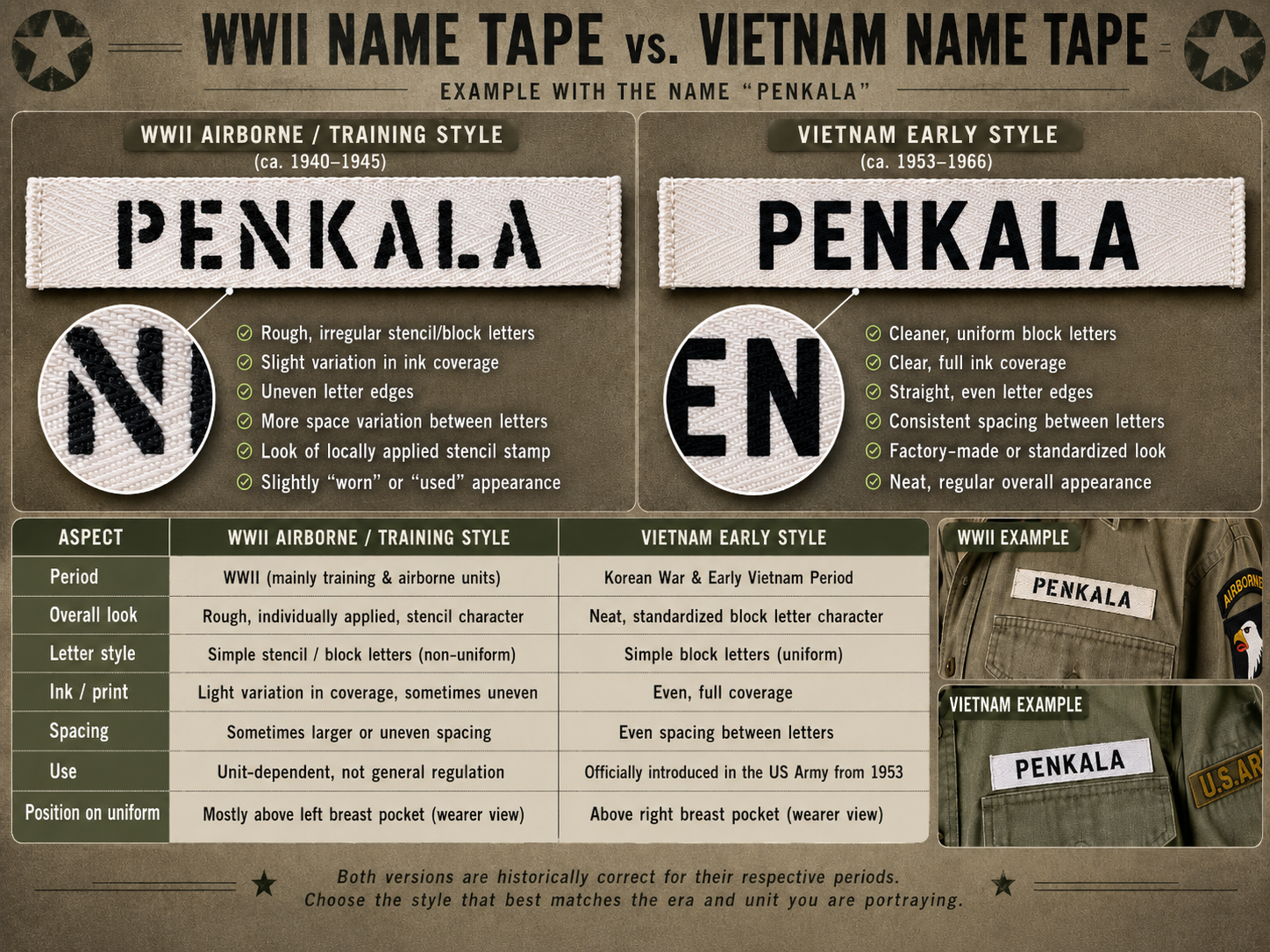
The requested surname is applied in black capital letters to an off-white cotton herringbone tape. When ordering, you can choose between two historical lettering styles.
WWII Airborne / Training Style
This version is based on the simple black-stamped name tapes used by certain American training and early airborne units during World War II.
The lettering has a slightly irregular stencil or block-letter appearance. Minor variations in ink coverage and spacing help recreate the practical, locally produced appearance of an original military name marking.
This WWII version is particularly suitable for:
- early US paratrooper impressions;
- Airborne Training and Parachute Test Platoon displays;
- HBT coveralls and selected HBT work uniforms;
- living history, film, theatre and museum displays.
Period photographs of early American paratroopers from 1940 show white name tapes above the wearer’s left breast pocket. This was not a general regulation name tape for the entire US Army, but a local or unit-specific practice.
Korean War / Early Vietnam Style
This version features a cleaner and more uniform black block-letter style. It is based on the white cloth name tapes introduced during the 1950s and still seen during the early American involvement in Vietnam.
The name tape was sewn above the wearer’s right breast pocket. A separate U.S. ARMY tape was normally worn above the left breast pocket.
The white tape with black surname is suitable for:
- Korean War impressions;
- US Army OG-107 utility uniforms;
- early Vietnam War impressions;
- early tropical combat uniforms;
- re-enactment, living history, film and theatre.
A nationally designated US Army name tape was introduced in 1953. White tapes with black names continued to be worn during the early Vietnam period. From the summer of 1966, they were increasingly replaced by subdued olive-drab tapes with black lettering.
Entering your name
Carefully enter the required surname when placing your order. The name will be reproduced as supplied and applied in capital letters.
Please check:
- the spelling of the surname;
- any prefixes or connecting words;
- the selected historical style.
Each name tape is individually made. Minor differences in ink coverage and letter placement may occur. With the WWII version, these small variations contribute to its authentic period appearance.
Sewing or gluing?
For a historically appropriate finish, we recommend sewing the name tape around its edges.
When the tape may need to be removed later, it can be attached with a limited number of small hand stitches. This helps reduce possible damage to the uniform.
Permanent fabric glue, iron-on backing and modern adhesive material were not the normal historical method of attaching WWII or Vietnam-era name tapes. Adhesive may be used as a modern display solution, but it is less suitable for an accurate re-enactment impression.
HISTORICAL CONTEXT
Name tapes during World War II
During World War II, there was no general US Army regulation requiring every soldier to wear a standardized cloth name tape above a breast pocket.
Clothing was normally identified internally by means of a name, service number or laundry mark. Visible exceptions did exist. Certain training organizations and early airborne units used white cloth name tapes to help instructors and soldiers identify individuals during training.
An American Infantry Journal issue from November-December 1940 shows early US paratroopers wearing HBT coveralls with white name tapes above the left breast pocket. These soldiers belonged to the early experimental parachute organization from which the 501st Parachute Battalion was formed.
This explains why original WWII name tapes and period photographs exist, even though such a tape is not appropriate for every US Army HBT uniform. Its use depended on the unit, training establishment and local instructions.
The lettering was not completely standardized either. Names could be applied by stencil, stamp or simple printing methods. It is therefore historically safer to describe this as a WWII Airborne / Training Style, rather than claiming that a single official WWII font existed. This is an inference based on the unit-specific WWII use and the later nationwide introduction of the name tape in 1953.
Name tapes during the Vietnam War
The cloth name tape was introduced throughout the US Army in 1953. Displaying the soldier’s surname made it easier to identify personnel wearing otherwise identical field and utility uniforms.
During the early Vietnam period, a white cotton tape with the surname in black lettering was worn above the right breast pocket. A black U.S. ARMY tape with yellow or gold lettering was normally worn above the left breast pocket.
The surname could be stencilled, printed or embroidered. Differences in letter width, height and spacing were common.
Because white and coloured insignia were highly visible in the field, subdued tapes were introduced from the summer of 1966. These featured black lettering on an olive-drab background. The change did not take place everywhere at once, so early and subdued versions continued to be worn alongside one another for a transitional period.
The Delware name tape on off-white cotton webbing is therefore intended for an early Vietnam impression, rather than a later subdued Vietnam uniform.